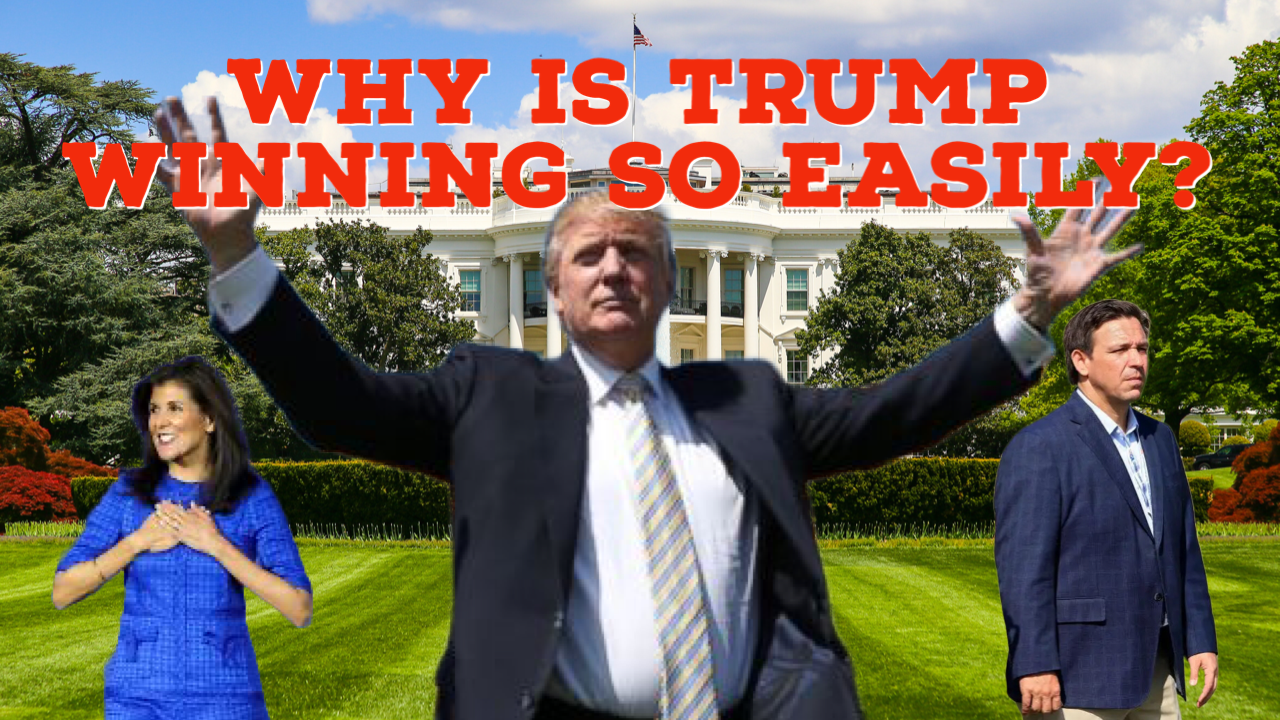
On Monday 15th January it’s the Iowa caucuses, the first ballot in the 2024 Republican Presidential Primary contest.
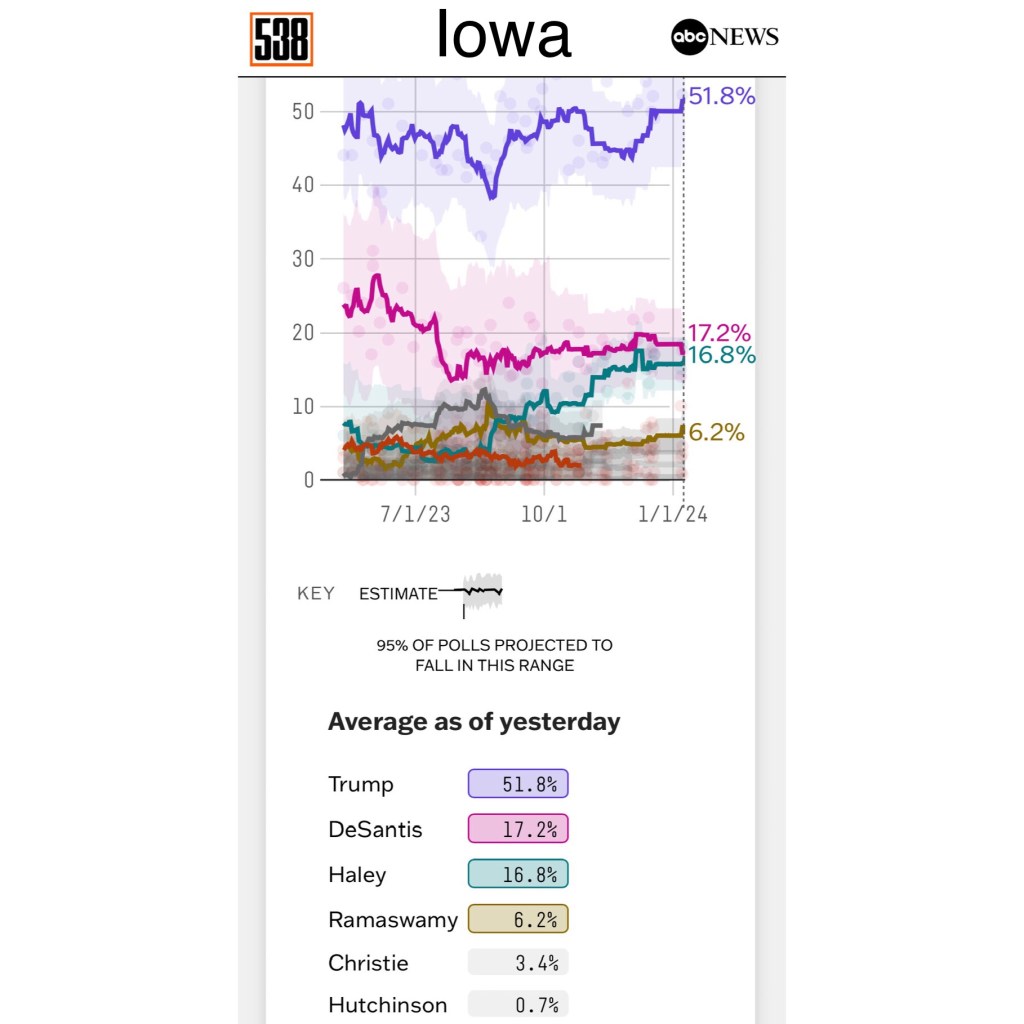
Trump is polling above 50% in Iowa, which makes him the overwhelming favourite to win the state.
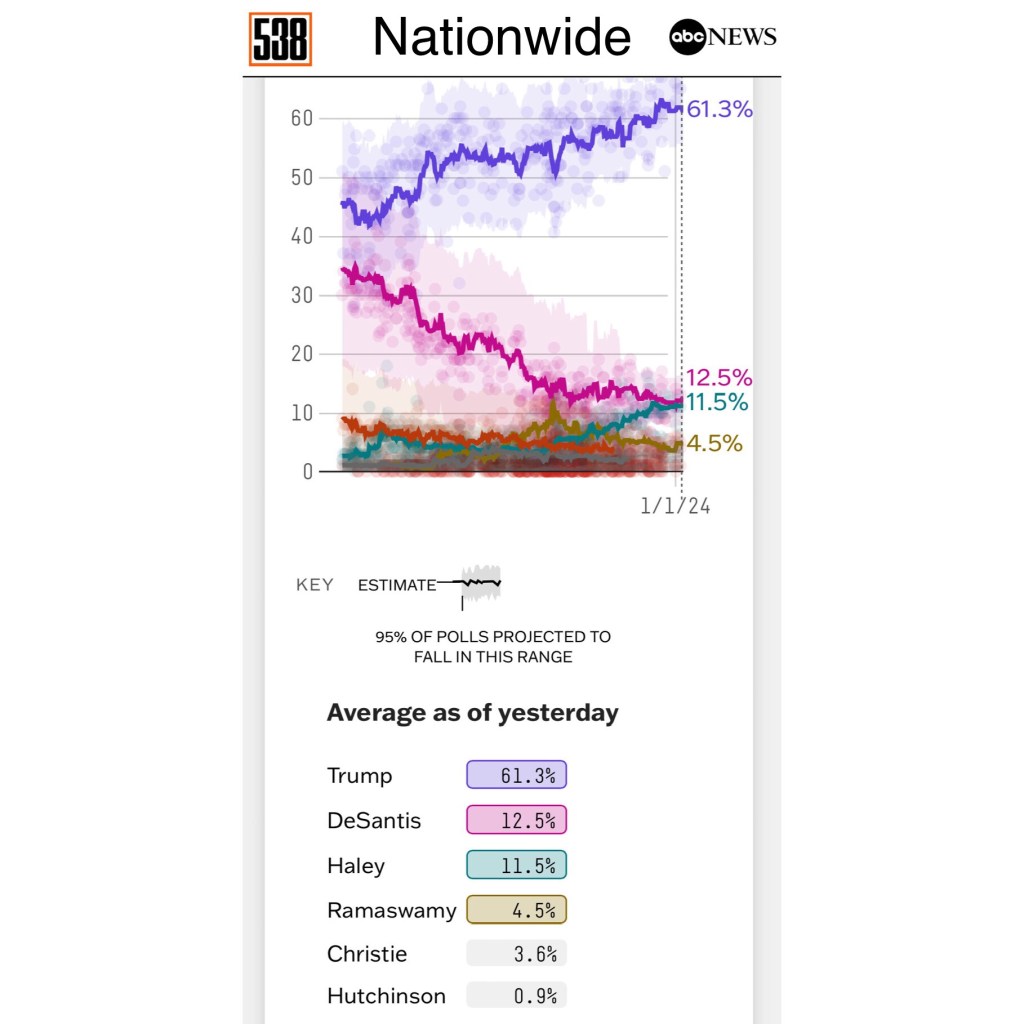
Trump is also polling over 60% nationwide and so is the undisputed front-runner in the race to win the nomination.
Why is Trump so dominant?
There are three core drivers of voter preferences in nomination races. Primary voters look at candidates and judge whether or not they deem them to be:
- Likely to be competent in office
- Representative of the values of the party
- Probable winners of the general election
An academic called Leonard Stark was the first to propose competence, acceptance from the party and electability as the three building blocks of a successful campaign for party leadership.
If a candidate scores particularly highly on all three measures, significantly over and above the competition, the Stark Model suggests that the candidate will win the primary election.
Trump is leading the primary polls so comfortably because the primary electorate perceive him as performing very well on all of Stark’s indicators.
Republican voters remember Trump as achieving some key things in office and so deem him competent. The economy, pre-pandemic, performed relatively well. There were no foreign conflicts in which the USA became involved, which is in sharp relief to the interventions under Biden in Ukraine, Gaza and now Yemen. The wall on the southern border was (albeit partially) built. And conservative judges were appointed to the Supreme Court which resulted in restrictions on abortions.
Trump has remoulded the Republican Party in his image. There is now a Make America Great Again (MAGA) movement that dominates the Republican Party; none of the top 4 Republican candidates have rejected the MAGA movement. As the Republican Party is now the party of Donald Trump’s ideology, it’s unsurprising that Republican voters largely believe that Trump represents the values of the party.
And Republican primary voters believe that Trump is electable. They can look at head-to-head Trump vs Biden 2024 polling and feel confident, particularly given how far pollsters underestimated Trump’s vote in advance of the 2016 and 2020 elections. Indeed, one poll showed that 60% of Republicans believe that Biden didn’t win the 2020 election legitimately and so Trump’s election-winning credentials have never been in doubt amongst the majority of primary voters.
Nikki Haley’s polling has surged recently. This is partly because she has consolidated the anti-Trump vote, but also because she is scoring well on Stark’s measures.
Haley is perceived to have performed well as Governor of South Carolina (competence); she has become the favourite Republican candidate amongst more liberal media outlets (voters see media endorsements as a sign of electability); she served in Trump’s government and has not rejected or attacked the MAGA movement (acceptance). She’s behind Trump in the polls because despite performing well on the three fundamentals of primary success, she scores lower on each measure than Trump.
Ron DeSantis has declined in the polls because whilst his competence and acceptability have remained intact, the more voters have seen of him the more they doubt he has what it takes to win in a general election. He’s been awkward on the campaign trail and shrunk (despite wearing height-boosting heeled boots) in the spotlight of the national media.
Chris Christie, before dropping out, performed so dismally because he ran explicitly as an anti-Trump candidate and so he was not deemed to represent party values. No amount of competence or electability could compensate for it.
It can be the case that candidates achieve close enough to parity on these fundamentals, and something else is required to convince voters to opt for one over another. And very occasionally, a candidate who doesn’t score particularly strongly across all three measures can perform very well in a primary regardless. The thing that can push a parity candidate into first place, or transform the fortunes of a sub parr candidate, is a well-constructed, well-told campaign narrative.
Trump is winning this primary contest so easily because he has not only won on the fundamentals, he also has the strongest narrative.
Trump’s character in his narrative is that he’s a rebel with a cause. His narrative is a timeless tale of a man who’s refusing to accept the diktats of the overlords and is calling on his supporters to revolt against the established order. He’s Hans Solo, Robin Hood and Maverick rolled into one and he’s taking on “The Deep State” – an amorphous body that manipulates the laws of the land to favour the elites and inflict injustice on the people.
Haley and DeSantis on the other hand, Trump’s closest challengers, have completely failed to construct a compelling character and narrative.
Haley’s communications have tried to say everything and ended up saying nothing. And DeSantis has avoided criticising Trump so studiously that he’s ended up sounding like an understudy rather than the main part.
While Trump might have a fight on his hands in New Hampshire, the second primary contest taking place in a week’s time, the fundamentals of his candidacy and the strength of his narrative make an upset in the final result incredibly unlikely.
You can learn more about what it takes to triumph in a primary by reading my new book Primed: five election narratives to win your party’s nomination.
 politicaladvertising.co.uk