Priti Patel has announced her candidacy to lead the Conservative Party.
In Leonard Stark’s seminal book “Choosing a Leader: Party Leadership Contests in Britain from Macmillan to Blair”, a theory of the recurring features of successful leadership bids is put forward.
According to Stark’s theory, there are three “fundamental” perceptions any leadership candidate needs to have: 1) good party values 2) competence in office 3) electability.
The three pillars of Priti Patel’s campaign which are called out in her key visual – unity, experience, strength – nod to each of Stark’s fundamentals.
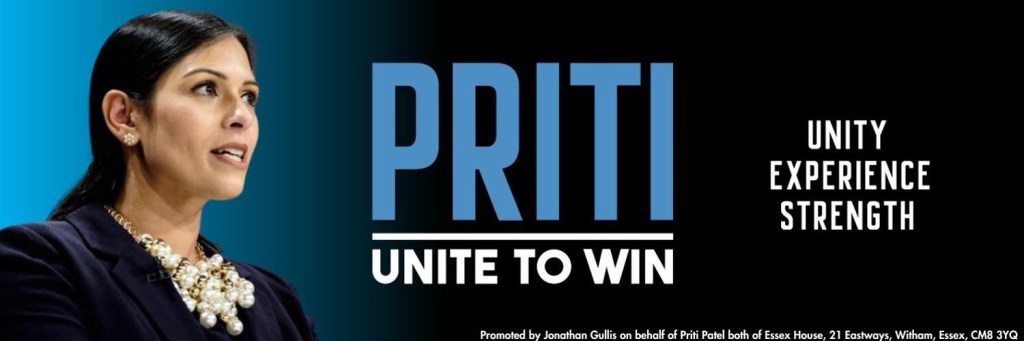
“Unity” is there to speak to her party values. She wants to convey she embodies the core principles of the party that are held by all factions.
“Experience” is designed to communicate that she will be competent in office. By highlighting her record she hopes to reassure fellow MPs and members that she can effectively manage the responsibilities of the office she is seeking.
“Strength” is there to imply she has the tenacity and determination to take on Labour and win a general election.
She has chosen unity as the theme to highlight in her slogan – positioning herself as a candidate who can bridge divides.
In my book Primed: Five election narratives to win your party’s nomination I recommend candidates who want to position themselves as the unity candidate adopt The Egalitarian narrative.
In the Egalitarian narrative the candidate: emphasises the values that the party holds dear; highlights how their candidacy can bring together seemingly disparate agendas; does everything they can to make themselves relatable; uses ritual and tradition to encourage a general sense of belonging amongst the electorate.
Party members always want unity, but The Egalitarian narrative is most potent when the fear of division is the dominant sentiment felt by the membership.
Nigel Farage and Reform UK are deemed by some to be a fundamental threat to the ongoing existence of the Conservatives. Some would argue a failure to move towards Reform UK means that the Conservative Party’s base will be terminally split; while others argue that evacuating the centreground is embracing electoral oblivion.
Priti Patel is well-placed to claim that she can hold the Conservative coalition together as she has credibility on Brexit and the issue of immigration and yet served honourably under more moderate leaders.
The moderate wing of The Conservatives is being represented by James Cleverly (and to a lesser extent by Tom Tugendhat) who is running as a continuity candidate.
The right-wing will have Robert Jenrick as their standard bearer (Kemi Badenoch also attracting lots of their support) who will likely run as a change candidate.
It will be interesting to see whether members are fearful enough of a victory by one wing or the other to opt for a unity candidate.
 politicaladvertising.co.uk